
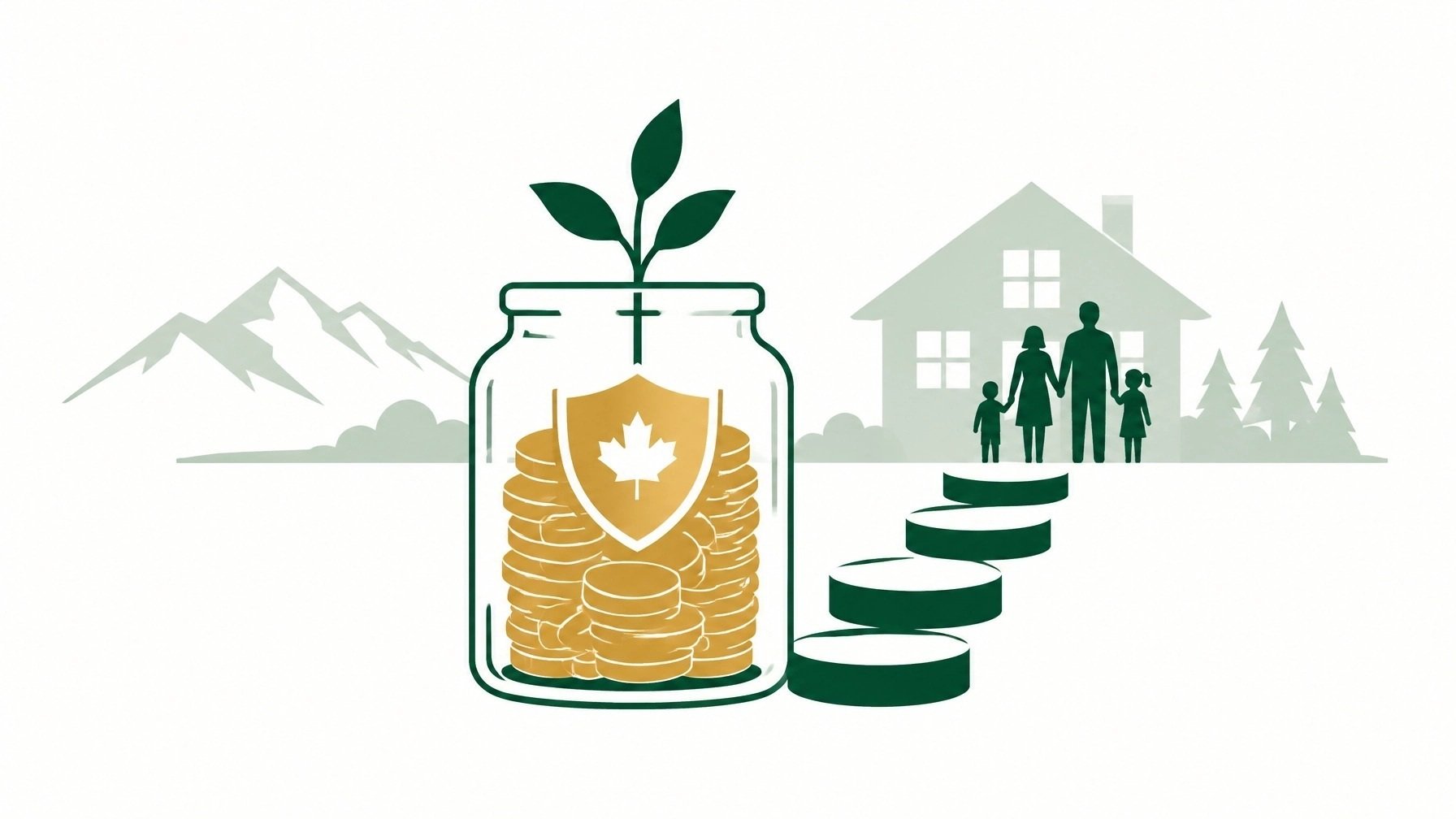
If you are waiting until you can save three months of expenses before starting an emergency fund,
the target may feel impossible.
Here is the simpler answer:
Enough to start is one week of essential expenses.
Not three months. Not six months. One week.
For many Alberta families, that may be roughly $300 to $800. It is not the final destination. It is the first rung of a ladder, and reaching that first rung can give you breathing room when a car repair, a missed shift, or an unexpected bill arrives.
You can start where you are. That is the whole point.
Emergency Savings Is a Ladder, Not One Giant Target
A common guideline is to build up three to six months' worth of essential expenses. The Financial Consumer Agency of Canada also discusses emergency savings in that range and recommends practical steps, such as setting up automatic transfers and using windfalls to build the fund.
But a guideline is not a requirement to begin.
Think of your emergency fund as four rungs:
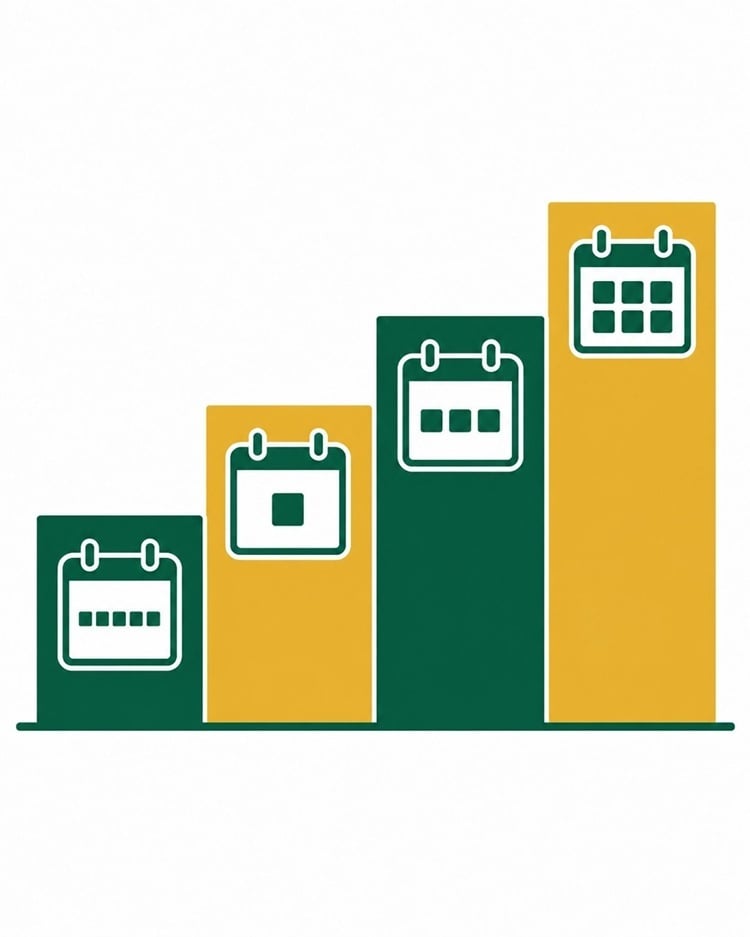
| Rung | What it covers | Example using $3,200 of monthly essentials |
| Rung one: One week | A first buffer for a smaller surprise | About $740 |
| Rung two: One month | A larger repair, bill or short income interruption | $3,200 |
| Rung three: Three months | A meaningful cushion during job or income disruptionA meaningful cushion during job or income disruption | $9,600 |
| Rung four: Six months | Greater protection for unstable or single-income households | $19,200 |
Your numbers may be lower or higher. There is no one-size-fits-all answer.
The ladder works because every rung is a real improvement:
• $300 can prevent one repair from going straight onto a credit card.
• $800 can help cover a deductible, urgent travel, or a temporary income gap.
• One month can give you time to think instead of immediately borrowing.
• Three or six months can provide important stability when work is uncertain.
Most families are not trying to leap from nothing to $19,200. They are taking the next manageable step.
Start with the first rung.
Calculate Essentials, Not Your Full Income
Your emergency fund is usually based on what your household must pay, not everything you normally spend.
That means you do not necessarily need to replace your full income. You need to protect the household basics.
Your essential monthly expenses may include:
• Rent or mortgage payments
• Utilities, heat, electricity and basic phone service
• Groceries and necessary household supplies
• Transportation, including fuel, transit, insurance and car payments
• Insurance premiums
• Minimum debt payments
• Childcare and other unavoidable family expenses
• Basic medical or prescription costs
You may not include restaurant meals, entertainment, gifts, vacations or optional subscriptions in the essential figure. Those expenses may affect your quality of life, but they can often be temporarily reduced during a financial emergency.
A simple example
Imagine a family in Edmonton has these monthly essentials:
• Housing: $1,800
• Groceries: $650
• Utilities and phone: $300
• Transportation: $300
• Insurance: $100
• Minimum debt payments: $50
Total essential expenses: $3,200 per month
The family’s first-week target is approximately $740, based on $3,200 divided by about 4.33 weeks in a month.
That first $740 is not meant to solve every possible problem. It is meant to make the next problem less overwhelming.
For a more detailed starting point, you can use the Financial Consumer Agency of Canada’s emergency-fund guidance and its budgeting resources.
Where Should You Keep an Emergency Fund?
Emergency savings should be:
1. Safe
2. Available within a day or two
3. Separate from everyday spending
A high-interest savings account can be a straightforward choice. It keeps the money accessible and makes it easier to see how much you have available.
A TFSA may also be a reasonable home for emergency savings, provided the money is held in a safe, accessible option such as cash or a high-interest savings product within the TFSA.
A TFSA may allow investment growth and withdrawals without tax in many ordinary situations. However, the important detail is this:
When you withdraw from a TFSA, the withdrawn amount generally returns to your contribution room on January 1 of the following calendar year, not immediately.
For example, if you withdraw $2,000 in 2026, that amount generally becomes available as contribution room again in 2027. If you put the money back into the TFSA during 2026 without enough unused room, you could over-contribute and face a penalty.
Always verify your available room through your records and the CRA’s TFSA contribution information.
What should you avoid?
Do not place money you may need next month into an investment that can fall sharply in value. Stocks and other market investments may be appropriate for long-term goals, but an emergency fund has a different job. It needs stability first.
That is an important distinction for anyone learning about investing for beginners in Canada.
What If There Is Nothing Left at the End of the Month?
You are not alone if your paycheque is already assigned before it arrives. Young families, renters, single-income households and people managing rising costs may have very little flexibility.
The answer does not have to be dramatic.
Try one or more of these approaches:
• Set up an automatic transfer of $10, $25 or $50 on payday.
• Direct part of a tax refund, bonus or gift into savings.
• Review one or two recurring costs instead of trying to rebuild your entire lifestyle.
• Save some seasonal, overtime or extra-shift income.
• Sell an item you no longer use and place the proceeds in the fund.
• When a loan is paid off, redirect part of that former payment to savings.
The FCAC provides a useful illustration: saving $10 per week creates $520 over one year, before considering interest.
Consistency matters more than the amount.
If you miss a month, that is not failure. Restart with the next paycheque. A financial plan is supposed to support real life, including difficult months.
Emergency or Want? Use a Simple Test
An emergency is generally:
• Unexpected
• Necessary
• Urgent
Examples may include:
• A job loss or sudden reduction in hours
• A necessary car repair
• A furnace or major home repair
• An urgent medical expense
• Travel for a serious family emergency
A sale is not an emergency. Neither is an unplanned purchase simply because the price is attractive.
This is not about judging your spending. It is about protecting the money for the reason you saved it.
When a genuine emergency happens, use the fund. That is what it is there for. Then rebuild it gradually
afterward.
Savings and Insurance Are Two Layers of Protection
An emergency fund and insurance do different jobs.
Savings can help with smaller and medium-sized disruptions. Insurance helps address risks that savings alone could never realistically cover.

For example:
• Emergency savings may help with a $900 car repair.
• Disability insurance may help replace part of your income if illness or injury prevents you from working.
• Accident and sickness coverage may address certain unexpected health-related financial risks.
• Life insurance may help protect dependents, mortgage obligations and future family needs if someone dies.
No realistic emergency fund can replace six months, or several years, of income for every household. That is why savings and insurance often work best as two layers.
Our insurance solutions can be reviewed as part of a broader plan, based on your income, dependents, debts, health considerations and priorities.
If Your Income Changes, Your Target May Need to Be Larger
Contractors, tradespeople, oil and gas workers, commission-based workers and self-employed Albertans may experience strong months and slow months.
In that situation, an emergency fund is not only for emergencies. It can also be a smoothing tool between seasons, contracts or busy periods.
You may want to work toward a larger target, often three to six months of essentials, or more depending on your circumstances.
Consider building separate categories if that helps:
• Emergency savings for unexpected necessary costs
• Income-smoothing savings for predictable slow periods
• Tax savings for amounts owed after a strong contract year
Keeping these purposes clear can reduce the temptation to use one account for everything.
There is no shame in having fluctuating income. Your financial plan should reflect how you actually earn money, not how a standard monthly-paycheque household earns it.
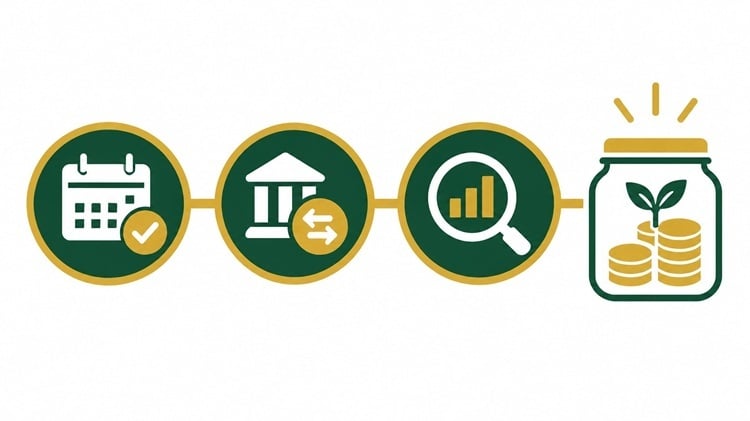
Your Three-Step Plan for This Month
You do not need a perfect budget before taking action.
1. Find your essential monthly number
Review the last 30 days of spending and identify housing, food, utilities, transportation, insurance, and minimum debt payments.
Write down one total.
2. Choose your first rung
Set a target of one week of essentials. If your monthly essentials are $3,200, your first target is about $740.
Then divide it into manageable transfers. For example:
• $25 per payday
• $50 per week
• $100 from a refund or extra shift
3. Automate and review once
Set the transfer for payday and choose a safe, accessible account. Review it once after 30 days. If the amount is too high, reduce it. If it is comfortable, keep going.
Small steps count.
The First Goal Is Breathing Room
You do not have to build the perfect six-month fund this week.
Start with one week. Then one month. Then decide what makes sense for your household, your work, your health, your debts, and your responsibilities.
If you would like help calculating your essential-expense number or coordinating savings, insurance and longer-term goals, you are welcome to learn more about our financial planning services or contact JK Asset Management. There is no obligation to arrive with a perfect plan or substantial savings.
Website: https://www.jkassetmanagement.ca/index
Phone: (780) 399-5471
Email: kapler@jkassetmanagement.ca
Contact page: https://www.jkassetmanagement.ca/contact
No Family Left Behind.
Educational disclaimer: This article provides general information for educational purposes and is not personalized financial, investment, tax, legal, or insurance advice. TFSA rules, insurance needs, account features, and suitable savings amounts depend on your circumstances and may change. Consider reviewing your situation with an appropriately qualified professional before making financial decisions.