

With a workplace pension, your employer has already answered part of the retirement-income question. A pension may provide a predictable monthly amount after you stop working.
Without one, the entire calculation is yours.
That is not a reason for alarm. It is simply a different starting point. You can still estimate what you may need using ordinary arithmetic: what will retirement cost, what income may arrive automatically, and what gap will your savings need to cover?
Let’s walk through it.
Step One: What Will Retirement Actually Cost?
A common rule of thumb says retirement spending may be about 60% to 80% of your pre-retirement income.
That can be a useful starting point, but it is not a personal answer.
If your household earns $80,000 before tax, that range suggests annual retirement spending of approximately:
• 60%: $48,000 per year
• 70%: $56,000 per year
• 80%: $64,000 per year
But why might your number be lower or higher?
Your mortgage may be paid off. Daily commuting may disappear. Work clothing, parking, lunches, and professional expenses may decline.
On the other hand, healthcare costs, travel, home repairs, helping adult children and replacing a vehicle may become more important. A retirement budget is not automatically a smaller working-life budget.
A practical household example
Imagine an Alberta household currently earning $80,000 per year before tax. They expect to retire with their mortgage paid off but still want to travel modestly and maintain their home.
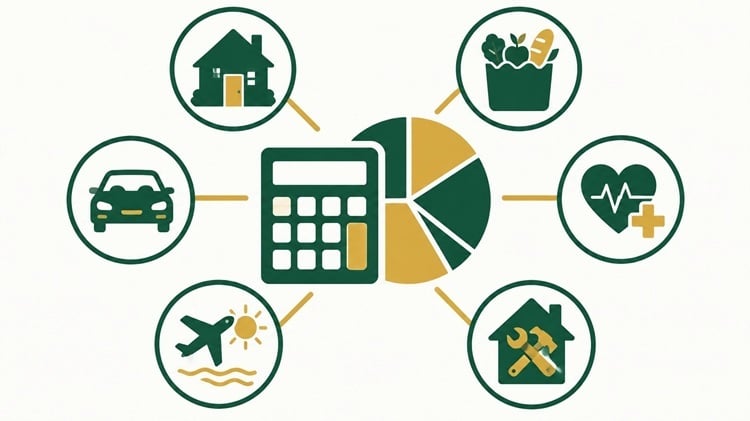
Their estimated annual retirement spending might look like this:
| Retirement Expense | Annual Estimate |
| Property taxes, utilities and home maintenance | $12,000 |
| Groceries and household needs | $13,000 |
| Transportation and vehicle costs | $7,000 |
| Healthcare and personal expenses | $5,000 |
| Travel and recreation | $8,000 |
| Gifts, family support and miscellaneous costs | $6,000 |
| Estimated annual spending | $51,000 |
This household does not necessarily need $80,000 of retirement income. Its first estimate is $ 51,000 per year, or about $4,250 per month before tax.
That is an illustration, not a projection. Your mortgage, location, health, family responsibilities and preferred lifestyle may produce a very different number.
Start with your real life, not a generic percentage.
Step Two: What Income Will You Actually Have?
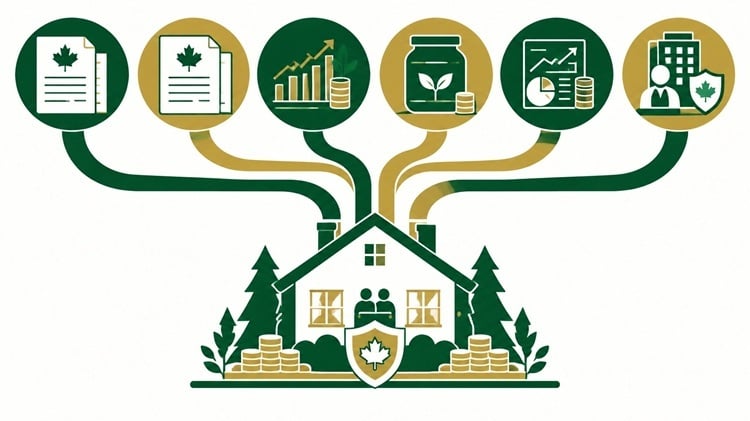
Once you estimate spending, add up the income sources you may receive.
Canada Pension Plan
The Canada Pension Plan, or CPP, is based on your contribution history and the age when you begin receiving it.
For 2026, the commonly cited average CPP retirement payment for new beneficiaries starting at age 65 is $877.01 per month, while the maximum is $1,507.65 per month. Most people will not receive the maximum.
Your CPP timing also matters:
• Starting at age 60 means a permanent reduction of up to 36%
• Starting at age 65 provides your calculated base amount
• Delaying to age 70 can increase the amount by up to 42%
Those percentages apply to your own calculated CPP pension, not automatically to the maximum.
For your personal estimate, check your official details through My Service Canada Account and review the Government of Canada’s CPP payment information.
Old Age Security
Old Age Security, or OAS, is a federal benefit generally available beginning at age 65, subject to eligibility rules and possible recovery tax.
For October to December 2026, the maximum monthly OAS amounts are approximately:
• $762.50 per month for ages 65 to 74
• $838.75 per month for ages 75 and over
These are maximum amounts. Your payment may differ.
The OAS recovery tax, often called the clawback, can apply when net world income exceeds the applicable threshold. For 2026 income, the threshold is near $95,323. The exact rules and income period matter, so review the Government of Canada’s OAS payment information and OAS recovery tax guidance.
Personal savings and investments
The rest may come from sources such as:
• RRSP savings and later RRIF withdrawals
• TFSA savings and withdrawals
• Non-registered investments
• Cash savings and GICs
• Rental income or business assets
• An annuity or other income solution
• A workplace pension, if one becomes available later
Government benefits may cover part of your retirement need. They usually do not cover the entire household budget.
Step Three: Find the Gap
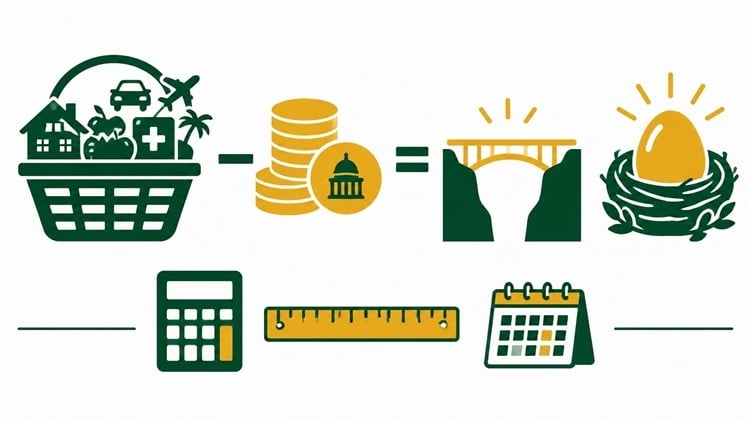
The basic arithmetic is simple:
| Estimated annual spending − expected government income = annual amount your own assets must help provide |
Return to the household spending estimate of $51,000 per year.
Suppose the household expects:
• CPP: $10,524 per year, using $877.01 per month as an illustration
• OAS: $9,150 per year, using $762.50 per month as an illustration
• Total government income: $19,674 per year
The estimated gap would be:
$51,000 − $19,674 = $31,326 per year
That does not mean the household must have $31,326 in cash every year forever. Investments may
continue producing income, withdrawals may change over time, and spending will not remain identical
each year.
But it gives the household a useful question:
How much capital may be needed to help fund an annual gap of approximately $31,326?
A clearly labeled capital illustration
Using a simple illustration, not a promise or projection, suppose someone wants to estimate a capital target by dividing the annual gap by 4%.
$31,326 ÷ 0.04 = $783,150
Under that simple assumption, the household might use approximately $783,150 as a rough planning reference.
This is not a guaranteed withdrawal rate. It does not account fully for taxes, inflation, investment returns, market losses, changing spending, longevity, or government-benefit changes. A different assumption produces a different result.
The point is not to find one perfect number. The point is to make the gap visible.
What Does the Simple Arithmetic Leave Out?
Several important factors can change the result.
Inflation over 20 or 30 years
A retirement budget estimated today may cost more in the future. Even moderate inflation can reduce purchasing power over a long period.
A $4,250 monthly budget today will not necessarily buy the same groceries, utilities, or repairs 20 years from now.
A retirement that lasts longer than expected
Retirement may last 25, 30, or more years. Planning only to age 80 may leave too little room for a longer life.
Longevity is not a problem to solve with fear. It is a reason to build flexibility into the estimate.
The order of investment returns
Two portfolios may earn the same average return over a long period but produce very different experiences.
A major market decline early in retirement, while withdrawals are being made, can reduce the assets available for later years. This is often called sequence-of-returns risk. In plain English, the order of good and bad market years can matter.
RRIF withdrawals and OAS
An RRSP generally must be converted by the end of the year you turn 71. If it is converted to an RRIF at that time, minimum withdrawals normally begin in the following calendar year.
RRIF withdrawals are taxable income. They can also increase the income used to determine whether OAS recovery tax applies. You can review the CRA’s RRIF guidance for current rules and prescribed factors.
A bridge account
You may choose to stop working before beginning CPP or OAS. In that case, you may need a bridge account. Cash or investments designed to help fund the years between leaving work and starting government benefits.
For example, retiring at 62 and starting CPP at 65 creates a three-year income bridge. The amount
needed depends on your annual spending and any other income available.
What If Your Income Changes From Year to Year?
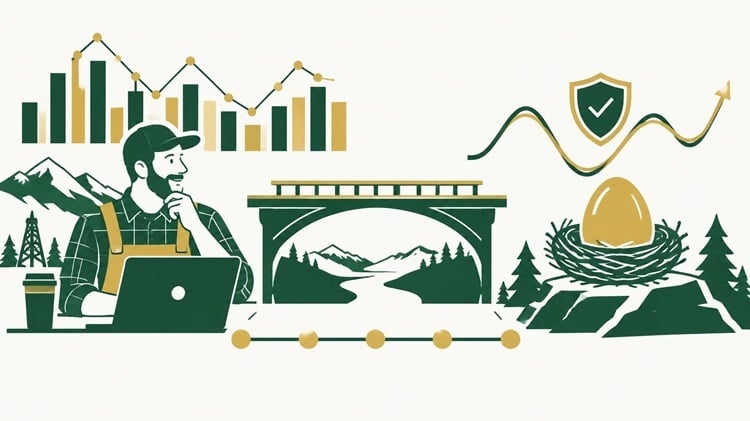
Contractors, tradespeople, oil and gas workers, business owners and other self-employed Albertans may not receive the same income every month.
That can make retirement planning feel difficult. It can also create planning opportunities.
A strong income year may be a useful time to review:
• RRSP contributions and available deduction room
• TFSA contributions and unused room
• Emergency savings
• Debt reduction
• Insurance protection
• Tax installments and business cash flow
• Long-term investment contributions
You do not need perfect market timing. Deliberately using available RRSP and TFSA room during stronger years may matter more than trying to predict the perfect day to invest.
A weaker year may call for more liquidity and fewer long-term commitments. A stronger year may allow you to build more retirement capacity.
The strategy should fit your income pattern, not pretend your income is perfectly steady.
Comparing Potential Retirement Income Sources
| Income Source | What It Is | When it Starts | How it is Taxed | Main Caveat |
| CPP | Government pension based mainly on contributions | Between ages 60 and 70 | Generally taxable income | Amount depends on contributions and start date |
| OAS | Federal senior benefit based mainly on age and residency | Generally from age 65 | Taxable; recovery tax may apply | Maximum is not guaranteed for everyone |
|
RRSP/ |
Personal registered retirement savings and withdrawals | RRSP withdrawals can start earlier; RRIF minimums generally begin after conversion | Withdrawals are taxable income | Withdrawals may affect tax and OAS recovery tax |
| TFSA | Personal savings and investments with tax-free withdrawals | Whenever you choose | Withdrawals are generally tax-free | Contribution room and investment performance vary |
| Non-registered savings | Investments or savings outside registered plans | Whenever you choose | Interest, dividends and capital gains may be taxable | Tax treatment depends on the investment and transaction |
| Workplace pension | Employer-sponsored retirement income | Depends on the plan | Usually taxable pension income | Not available to every worker and plan rules differ |
A Simple Retirement Income Worksheet
Fill in the numbers you know today. Leave blanks where you need official information.
Estimated annual retirement spending: $__________
CPP estimate at age 60: $__________
CPP estimate at age 65: $__________
CPP estimate at age 70: $__________
OAS estimate: $__________
Other predictable income: $__________
Estimated government and other income: $__________
Estimated annual gap:
$__________ spending − $__________ income = $__________
RRSP/RRIF balance: $__________
TFSA balance: $__________
Non-registered savings: $__________
Other assets or income: $__________
Years between retirement and starting CPP/OAS: ______ years
Bring your questions, including the numbers that feel uncertain. A personalized financial plan can help integrate spending, government benefits, investments, insurance, and tax considerations into a single, understandable picture. If you are looking for financial planning Edmonton families can discuss in plain language, the first conversation does not require a perfect plan or substantial savings.
Start With the Number You Can See
Without a workplace pension, you are responsible for more of the retirement-income arithmetic. But the arithmetic is still manageable.
Estimate the spending. Add the income. Find the gap. Then revisit the assumptions as your life changes.
Your plan may need to account for fluctuating income, inflation, health, family responsibilities, taxes, and a longer retirement. That is why ongoing wealth management Alberta support is not about choosing one product and walking away. It is about reviewing the moving parts together.
For official CPP, OAS, and tax figures, use Service Canada and the Canada Revenue Agency. The figures in this article are educational illustrations, not personalized projections or recommendations. Actual outcomes depend on your contribution history, income, expenses, investments, taxes, inflation, longevity, and other circumstances.
If you would like to talk through your worksheet, contact JK Asset Management:
• Website: https://www.jkassetmanagement.ca/index
• Phone: (780) 399-5471
• Email: kapler@jkassetmanagement.ca
• Contact page: https://www.jkassetmanagement.ca/contact
There is no obligation to have all the answers before you begin.
No Family Left Behind.
Educational disclaimer: This article is for general information only and is not tax, legal, or investment advice. The illustrations are not guarantees, forecasts or personalized recommendations. Consider your circumstances and obtain appropriate professional guidance before making financial decisions.