
You may already have a TFSA. But is it doing everything it could for you?
Many Canadians still think of a Tax-Free Savings Account as a basic savings account. In reality, a TFSA is an account that can hold different types of investments, including cash, GICs, mutual funds, ETFs and bonds.
That flexibility can make it useful for emergency savings, a future home, children’s expenses, retirement preparation and other long-term goals.
The right strategy depends on your income, timeline, comfort with investment risk and need for access to the money. There is no one-size-fits-all answer.
Still, a few practical principles can help.
First, understand your 2026 TFSA room.
The 2026 annual TFSA contribution limit is $7,000.
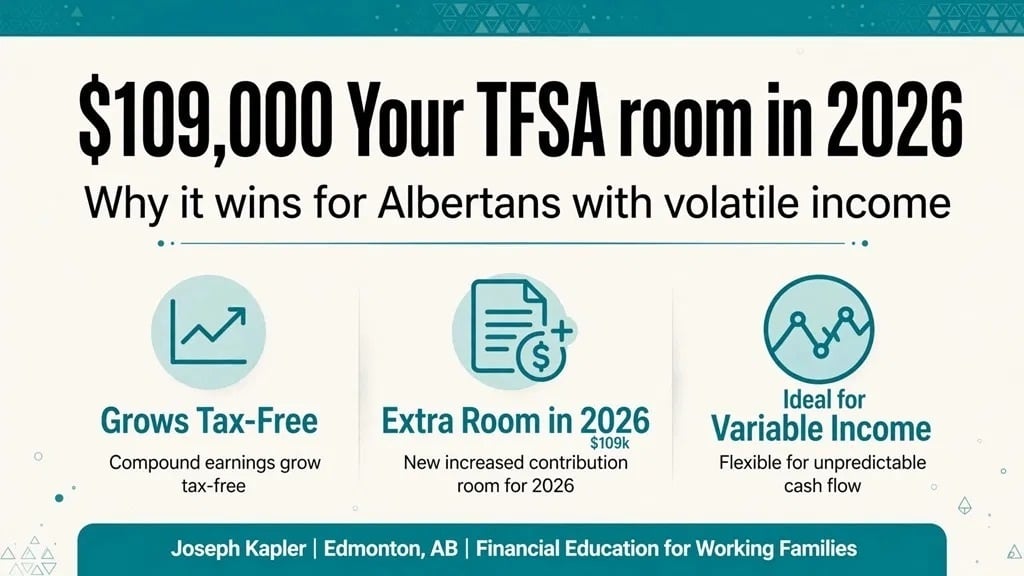
The cumulative maximum is $109,000 for someone who:
• Was at least 18 years old in 2009
• Has been a Canadian resident since 2009
• Has never contributed to a TFSA
Your personal room may be different. It depends on your age, residency, previous contributions and withdrawals.
Unused contribution room carries forward indefinitely. If you did not contribute in earlier years, that room may still be available to you.
Withdrawals are generally added back to your contribution room, but not immediately. A withdrawal made in 2026 is usually added back on January 1, 2027. You may only recontribute it during 2026 if you already have enough unused room.
Before contributing, check your personal information in CRA My Account and review the CRA’s TFSA contribution room guidance.
A mistake can be costly. Over-contributions may be subject to a 1% tax per month on the excess amount. Keep your own records as well, because financial institutions may report transactions to the CRA after a delay.
Now let’s look at six ways to use your TFSA more intentionally.
1. Use your TFSA for flexible long-term goals
A TFSA does not have to be reserved for one specific purpose.
You can use it to support:
• A future home renovation
• A vehicle purchase
• A child’s education
• A career change
• A sabbatical
• Retirement savings
• A growing emergency reserve
• Your personal financial independence goal
That flexibility is especially valuable for working families and people with changing incomes.
A contractor may have a strong year followed by a slower one. An oil and gas worker may receive overtime or a bonus that varies from year to year. A self-employed person may need savings that can serve more than one purpose.
Your TFSA can provide a place to build those savings while keeping the money accessible and allowing tax-free growth.
Think of your TFSA as a flexible financial room in your household plan. It can support more than one
goal, as long as you understand what each dollar is meant to do.
The simple version: Use your TFSA to create options, not just to chase a specific number.
2. Match the investment to your timeline
The best TFSA investment depends partly on when you will need the money.
Money needed soon should generally be treated differently from money you may leave invested for
10 or 20 years.
| Your Timeline | Examples | Options That May be Considered |
| Short Term: 0–2 years | Emergency expenses, upcoming bill, vehicle purchase | Cash, savings products or short-term GICs |
| Medium term: 3–7 years | Renovation, education, home upgrade | A balanced mix, GICs or other investments suited to your risk tolerance |
| Long term: 8+ years | Retirement, financial independence, long-term wealth building | Diversified investments such as mutual funds or ETFs, depending on your circumstances |
This is not a universal formula. Your emergency fund, income stability, and comfort with market changes also matter.
If you need the money next summer, a highly volatile investment may cause unnecessary stress. If you are saving for retirement 20 years from now, leaving everything in cash may limit your growth potential.
GIC and savings rates have been relatively flat through 2026. That means trying to predict every small rate movement may not be worth your energy. For many families, consistency matters more than perfect timing.
Ask yourself: What job does this money need to do, and when will it need to do it?
3. Automate manageable amounts
You do not need to contribute the full $7,000 annual limit to make progress.
Start with an amount that fits your real budget:
• $25 per week
• $50 every two weeks
• $100 per month
• A portion of each paycheque
• A percentage of seasonal or contract income
At $50 per month, you would contribute $600 over a year. At $100 per month, you would contribute $1,200.
That may not feel dramatic. But it creates a repeatable habit and reduces the pressure to find a large amount of money all at once.
For fluctuating income, you might use two layers:
1. A small automatic contribution that continues every month
2. Additional contributions during stronger income periods
For example, a contractor could automate $50 per month and add $500 after a particularly strong project. A family could direct part of a tax refund, bonus, or annual payment into the TFSA after reviewing other priorities.
Small, deliberate steps count.
The goal is not to prove that you can save perfectly. The goal is to make progress easier to repeat.
4. Use your TFSA alongside an RRSP, not instead of one
A TFSA and an RRSP can both support long-term planning, but they work differently.
| Feature | TFSA | RRSP |
| Contributions | Not usually tax-deductible | May reduce taxable income |
| Investment Growth | Generally tax-free | Tax-deferred while inside the RRSP |
| Withdrawals | Generally tax-free | Usually taxable as income |
| Room after withdrawal | Usually added back the following year | Generally does not return, except through specific programs |
| Common uses | Flexible savings, medium- and long-term goals | Retirement savings and current tax planning |
An RRSP may be useful when your current income and tax rate are relatively high, especially if you expect a lower taxable income in retirement.
A TFSA may be useful when you want flexibility, anticipate needing the money before retirement,or expect your future tax situation to be similar or higher.
Many households can benefit from using both, rather than treating them as competing choices.
For example:
• Use an RRSP for retirement-focused savings and possible tax deductions
• Use a TFSA for flexible savings and future spending needs
• Keep emergency savings accessible
• Review the mix as income and family circumstances change
The right balance depends on your goals, tax situation, debt, employer benefits and retirement timeline.
5. Use your TFSA for emergencies and mid-term goals
Your TFSA can help create financial breathing room.
That does not mean every dollar in it should be invested for growth. Part of the account may be held in cash or a suitable savings product if you may need it soon.
Consider using your TFSA for:
• A home or vehicle repair reserve
• A temporary income gap
• Medical or family expenses
• A planned renovation
• A professional certification
• A future move
• A parental leave savings plan
Before investing, consider whether you have enough money outside the TFSA to cover immediate bills. Also consider the liquidity and potential fluctuations of anything you hold inside the account.
One important reminder: If you withdraw $4,000 in 2026, you generally cannot assume that you can put $4,000 back into the TFSA later in 2026. That amount usually returns to your contribution room on January 1 of the following year.
Read CRA’s TFSA withdrawal rules before moving money in and out.
6. Review your TFSA once or twice a year
You do not need to monitor your TFSA every day.
For most families, a review once or twice a year may be enough to ask:
• Am I contributing within my available room?
• Has my income changed?
• Has my family situation changed?
• Do I need more accessible savings?
• Is the investment still appropriate for my timeline?
• Have I made withdrawals that affect next year’s room?
• Does my TFSA still fit with my RRSP and other savings?
• Has my comfort with investment risk changed?
A review can be especially helpful after a new job, marriage, separation, home purchase, inheritance, business change, or major shift in income.

How financial planning in Edmonton can make the plan personal
Searching for financial planning in Edmonton often brings up general rules and product choices. But the more important question is how those rules fit your household.
A family with a mortgage, two young children, and fluctuating overtime income may need a different TFSA approach than a single person with a workplace pension.
At JK Asset Management, we can help you look at the full picture, including:
• Income and expenses
• Emergency savings
• Debt and mortgage priorities
• TFSA and RRSP contributions
• Insurance protection
• Retirement objectives
• Investment time horizon
• Risk tolerance
• Your personal Financial Independence Number
You do not need a perfect plan before starting. You do not need a large account balance. Bring your questions and your doubts.
We can begin with where you are.
Your next step can be simple.
Check your TFSA room through CRA My Account. Write down your current balance, contributions and
withdrawals. Then decide whether one small automatic contribution would fit your budget.
That may be enough for today.
If you would like help connecting your TFSA to the rest of your financial plan, you are welcome to contact JK Asset Management to book a conversation. You can also visit our website at https://www.jkassetmanagement.ca/index, call (780) 399-5471, or email kapler@jkassetmanagement.ca. There is no obligation to make a decision, and you do not need to understand every technical detail before we begin.
Consistent steps. Clear choices. A plan built around your life.
Educational disclaimer
This article is for general educational purposes and is not personalized financial, investment, tax, or legal advice. TFSA rules, contribution room, and tax outcomes depend on your individual circumstances. Investment values can rise or fall, and past performance does not guarantee future results. Confirm your personal contribution room with the CRA and consider speaking with a qualified professional before making financial decisions.