

Starting January 1, 2027, the base Canada Pension Plan contribution rate is scheduled to drop from 9.9% to 9.5%.
That sounds significant. But what will it mean for you?
For an Alberta employee earning approximately $70,000 per year, the employee portion of the change amounts to roughly $133 per year, or about $11 per month, before accounting for the exact payroll calculation. Employers will also see a similar reduction in their share. If you are self-employed, you pay both sides of CPP, so the difference may be approximately twice as large.
It is real money.
But it is not a retirement solution by itself.
The more useful question is: What should you do with the extra money?
There is no one-size-fits-all answer. Your best choice may depend on whether you are managing debt, building emergency savings, working seasonally, supporting a family, or trying to create a retirement plan without a workplace pension.
Let’s walk through it together.
First, What Is Actually Changing?
A CPP contribution is money paid into the plan while you work. An employee generally pays one portion, while the employer pays the other. A self-employed person is responsible for both portions.
A CPP benefit is money you may receive later, such as a retirement pension, disability benefit or survivor benefit.
Those are not the same thing.
The 2027 change is a reduction in the base contribution rate. It is not a cut to your future CPP benefit. Your eventual CPP benefit will still depend on factors such as:
• How much you earn
• How long you contribute
• Your contribution history
• When you begin receiving CPP
• The rules that apply to the base and enhanced portions of CPP
In 2026, the employee and employer contribution rates for the main pensionable earnings range are 5.95% each, including the enhancement. The Year’s Maximum Pensionable Earnings is $74,600, and the maximum employee contribution is $4,230.45. A self-employed person may contribute up to $8,460.90.
For 2027, the base portion is expected to decline from 4.95% per side to 4.75% per side. The enhanced portion remains separate. That means the total employee rate on the main earnings range may move from 5.95% to approximately 5.75%.
The exact amount on your paycheque will depend on your income, payroll schedule and whether you reach the annual CPP maximum.
Why the Maximum CPP Benefit May Not Be Your Number
The maximum CPP retirement pension at age 65 is listed at approximately $1,507.65 per month in 2026.
That number can sound reassuring. But the average monthly CPP retirement pension for new age-65 beneficiaries is much lower, at approximately $877 per month.
Why does that gap matter?
Because many people see the maximum and assume it is what they will receive. It usually is not.
Receiving the maximum generally requires a long history of contributing at or near the annual maximum. Periods of lower income, time away from work, part-time employment, career changes, caregiving, disability, or fluctuations in self-employment income can all affect your record.
CPP can be an important foundation. It is not designed to replace your entire working income.
If you are planning for retirement in Edmonton, Calgary, Fort McMurray or elsewhere in Alberta, consider
CPP as one part of a larger plan that may also include personal savings, a TFSA, an RRSP, workplace
benefits, investments, rental income or other sources.
CPP is a foundation, not the whole house.

Six Practical Ways to Use the Extra Money
The 2027 change may create a small amount of breathing room. Here are six ways you could use it.
1. Cover an Immediate Cash-Flow Gap
If your household budget is already tight, the first priority may be keeping up with everyday expenses.
That could mean helping with:
• Groceries
• Fuel
• Utilities
• Childcare
• Mortgage or rent
• Seasonal work gaps
• Unexpected household costs
There is no shame in using the money for today. Financial planning is not about forcing every dollar into a long-term account while your current budget is under pressure.
If an extra $11 per month helps you avoid missing a bill or using a credit card for groceries, that may be the most valuable use of the money right now.
Stability comes first.
2. Build a Small Emergency Buffer
If your cash flow is manageable, consider directing the money into a separate emergency savings account.
You do not need to begin with a six-month emergency fund. Start with something practical:
• $100
• $250
• $500
• One month of essential expenses
For a seasonal worker, contractor, tradesperson or oil and gas worker, a cash reserve can be especially valuable. Income may be strong during one part of the year and less predictable during another.
Even $11 per month becomes $132 over a year, before interest. More importantly, it creates a habit.
A small buffer can help you handle a vehicle repair, short work interruption, or urgent family expense without immediately turning to high-interest debt.
Start where you are. Build from there.
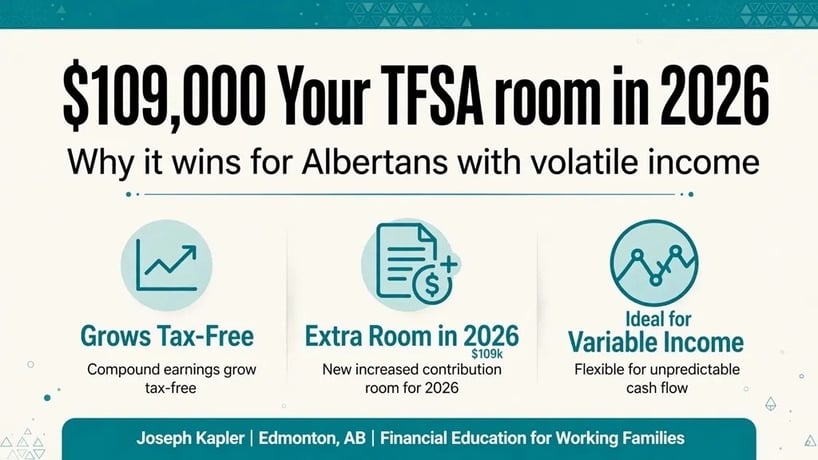
3. Add It to a TFSA
A Tax-Free Savings Account may be appropriate if you want flexible, tax-free growth and access to your money when needed.
Depending on your circumstances, a TFSA can be used for:
• Emergency savings
• A future home purchase
• A vehicle replacement
• Children’s education
• Retirement savings
• A business or career transition
Investment growth inside a TFSA is generally not taxed, and withdrawals are generally tax-free. However, the right investment within the account depends on your time horizon and comfort with risk. A short-term emergency fund should not necessarily be invested the same way as money intended for retirement 20 years from now.
If your income fluctuates, the flexibility of a TFSA may be especially helpful. You can contribute more during strong years and reduce contributions when work slows down.
Learn more through the Government of Canada’s TFSA information, then review how it fits into your broader financial planning.
 4. Contribute to an RRSP
An RRSP may be useful when you are in a higher-income tax year and expect your income to be lower in retirement.
The potential benefit is twofold:
1. You may receive a tax deduction for eligible contributions.
2. Investment growth is generally tax-deferred while it remains inside the RRSP.
For example, a contractor may have one year with unusually strong income and another year with lower earnings. The higher-income year may be a more valuable time to consider an RRSP contribution, although personal circumstances matter.
RRSPs are less flexible than TFSAs in some situations. Withdrawals are generally taxable, and withdrawing money may affect your long-term retirement savings. That does not make an RRSP bad or good for everyone. It means the account should be chosen intentionally.
If you have a workplace pension, employer matching program or variable income, the right combination of RRSP and TFSA savings may change over time.
The best account is the one that fits your life, not simply the one with the most familiar acronym.
5. Pay Down Higher-Interest Debt
If you have a credit card balance, payday loan, high-interest line of credit, or other expensive debt, paying it down may provide a strong and predictable benefit.
An $11 monthly payment may seem small, but repeated payments can reduce interest and shorten the time it takes to become debt-free.
You might direct the extra money toward:
• The debt with the highest interest rate
• The smallest balance for psychological momentum
• A debt with a promotional rate that is about to expire
The right method depends on your situation. If you have several debts, a clear repayment plan can help you see where each dollar is working hardest.
Paying down debt is not as visually exciting as investing. But lowering interest costs can create breathing room, and breathing room is part of financial security.
6. Review Life and Disability Insurance Protection
What happens to your household income if you cannot work for several months?
What would happen if a spouse or partner died unexpectedly?
These are difficult questions. They are also important, particularly if your family depends on your income, you have a mortgage, or you are self-employed without workplace benefits.
An extra $11 per month will not necessarily fund a large insurance policy. But it may be a reason to review whether your current coverage is still appropriate.
You may need to consider:
• Life insurance for income replacement
• Mortgage protection
• Disability insurance
• Accident and sickness coverage
• Coverage for business or contractor income
• Protection for a spouse or dependent children
Insurance should be designed around your income, debts, dependents, existing coverage, and household responsibilities. The goal is not to buy the largest policy available. The goal is to reduce the financial shock of a serious event.
Protecting your income is part of retirement planning Alberta families should not overlook.
 What If Your Income Changes From Year to Year?
For someone with a steady salary, the 2027 CPP reduction may be easy to direct automatically.
For a contractor, tradesperson, oil and gas worker or self-employed Albertan, the answer may change
each year.
In a strong income year, you may prioritize:
• RRSP contributions
• Tax planning
• Debt reduction
• Insurance protection
In a slower year, you may need to prioritize:
• Cash flow
• Emergency savings
• Tax installments
• Essential household expenses
That is not a failure of planning. It is reality.
A good plan should be flexible enough to reflect changes in income, family needs, health, work opportunities, and financial priorities.
The Simple Next Step
When the CPP change begins in 2027, do not feel pressured to make a dramatic decision.
Check your first few paycheques. Estimate the actual difference. Then ask:
• Do I need the money for current expenses?
• Is my emergency fund large enough?
• Do I have high-interest debt?
• Am I using my TFSA or RRSP intentionally?
• Would my family be financially protected if I became disabled or died?
• Am I relying too heavily on CPP for retirement?
You can start with one answer.
If you would like help reviewing your options, JK Asset Management provides personalized financial planning in Edmonton and across Alberta, including retirement planning, investment guidance, insurance reviews and ongoing financial education.
There is no requirement to have a perfect plan, substantial savings, or every answer prepared. Bring your questions and your doubts. We can start with where you are.
Contact JK Asset Management
Website: https://www.jkassetmanagement.ca/index
Phone: (780) 399-5471
Email: kapler@jkassetmanagement.ca
Contact Page: https://www.jkassetmanagement.ca/contact
A Calm Educational Note
This article is for general educational purposes only and is not personal financial, tax, legal, or insurance advice. CPP rates, limits, and benefit amounts may change, and individual results depend on your earnings, contribution history, employment status, tax situation, goals, and other circumstances. Before making a financial decision, consider speaking with a qualified professional who can review your situation in person.